
Western Australia is facing an election in a few weeks and three issues are emerging as important: firstly, the condition of the state’s finances (and the myth of one party being better financial managers); secondly, the privatisation of the electricity provider, Western Power; thirdly transport questions centring on the construction (or otherwise) of Roe 8 and the Perth Freight Link. I am interested here in how I as a Christian might make sense of what is happening in the Beeliar Wetlands.
Background.
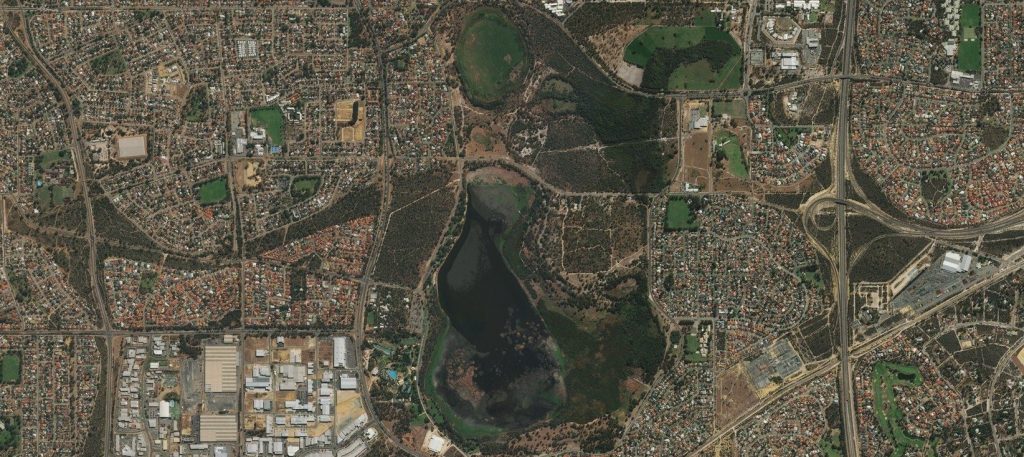
The Beeliar Regional Park occupies some 384 hectares south of Perth, Western Australia. The area contains more than 220 plant species and 123 bird species and is an important nesting site of the endangered Carnaby Cockatoo. It is a unique chain of interconnected lakes and bushland with unusual and rare makeup. The area also includes sites of historical and cultural significance. (1) The problem stems from a proposed freeway extension – Roe 8 – that goes through the area. It was originally planned in the 50s when Perth was a very different place. Apart from the significan environmental impact, experts have raised serious concerns on both the need and effectiveness of the extension for a modern Perth transport system.
Even though I do not live in the affected area, I have been joining in the protests, supporting those in the protests, writing members of parliament and generally trying to have the work stopped. I feel no conflict between these activities and my Christian faith, yet it was important to me to understand how a Christian could or should relate to this (and similar) environmental issues.
God’s Relationship to Humans and the Natural World.
The key starting point is well expressed by William of Ockham (of the famous razor) when he contended that the only necessity is God and everything else is radically contingent. (2) That is to say, everything in existence – humans and animals, trees and plants, animate and inanimate, all of nature – are wholly and completely dependent on God. There simply would be nothing if it were not for the freedom and desire of God to create. This already changes the dynamic toward a God/Christ focus. It turns us away from a flawed theology of anthropocentrism: “a view of the world as existing primarily to serve the needs and desires of humankind.” (3)
A second point follows from this: God is unique and separate from creation. “Christian faith,” says Daniel Migliore, “affirms the radical otherness, transcendence, and lordship of God.” (4) That is not to say that God is remote and distant as Christians affirm God as transcendent and, at the same time, immanent – close and near, intimate. It does speak to God being ontologically different to the created order and that creation itself is not divine in and of itself. As I have found, this does not leave the plants, animals or people open to exploitation.
A third point speaks to why God created. God did not have to create, but did so for “good and sufficient reasons”; for the glory of God. (5) The things God created are good; and not just good but very good (Genesis 1:31). In the words of the psalmist:
The heavens declare the glory of God;
the skies proclaim the work of his hands.
Day after day they pour forth speech;
night after night they reveal knowledge.
They have no speech, they use no words;
no sound is heard from them.
Yet their voice goes out into all the earth,
their words to the ends of the world. (6)
Or, as David Bentley Hart paraphrases the writings of Gregory of Nyssa (c335 – c394):
Creation is a wonderfully wrought hymn to the power of the Almighty: the order of the universe is a kind of musical harmony, richly and multifariously toned, guided by an inward rhythm and accord, pervaded by an essential ‘symphony’; the melody and cadence of the cosmic elements in their intermingling sing of God’s glory, as does the interrelation of motion and rest within created things; and in this sympathy of all things one with the other, music in its truest and most perfect form is bodied forth. (7)
How Might Christians View the Environment?
This is all well and good, delightful theory, but what is important to me as a Christian looking at the beauty and wonder of the Beeliar wetlands and woodlands is this question: what does it mean for me as a believer on the ground? Does my faith give me free reign, as the caricatures might suggest, to hack, slash and burn? It seems to me the clear answer is ‘no.’
All of God’s creation is important and valuable. At each stage of the creation story, God declares the result to be not just adequate, not there to take up space but ‘good’ (Genesis 1:12, 18, 21, 25) and indeed, the final result ‘very good’ (Genesis 1:31). To say that each element of creation is good is to make a statement of value and is not to be understood as the same as usefulness. (8) All creatures, therefore, are “called in their own distinctive way to praise and glorify God.” (9)
The world does not belong to humans or animals or plants but to God and God alone. All creation is good in God’s eyes and as Gregory of Nyssa expresses, the biblical view is one of interconnectedness, we are indeed sharers of the earth.
Finally, Christians look forward to a great gathering into God at the end of history. Nature is not discarded at this time but is a part of the new dynamic: we await a new heaven and a new earth (Revelation 21).
Conclusion.
The ideas I have outlined here do not provide sufficient reasons on their own to save this or any other wetland environment, and this is only a few threads in a much broader tapestry – there is much richer theology to be explored here. I do suggest, however, that the ideas outlined here provide an accurate Biblical and theological framework for approaching the destruction of God’s creation. In the case of the Beeliar Wetlands, the additional economic, transport, social and environmental arguments combined with theological arguments such as these provide sufficient reason to save rather than destroy.
For more information, visit Save Beeilar Wetlands and Rethink the Link.
References.
(1)
Save Beeliar Wetlands
http://www.savebeeliarwetlands.com/wetlands/article/what_are_the_beeliar_wetlands
(2)
Spade, Paul Vincent and Panaccio, Claude. “William of Ockham”, The Stanford Encyclopedia of Philosophy (Winter 2016 Edition), Edward N. Zalta (ed.), URL = <https://plato.stanford.edu/archives/win2016/entries/ockham/>.
(3)
Migliore, D. (2004). Faith Seeking Understanding (2nd ed.). Grand Rapids, MI: Wm. B. Eerdmans Publishing Co. p. 94.
(4)
Migliore, D. (2004). Faith Seeking Understanding (2nd ed.). Grand Rapids, MI: Wm. B. Eerdmans Publishing Co. p. 100 – original italics.
(5)
Erickson, M. (2013). Christian Theology (3rd ed.). Grand Rapids, MI: Baker Academic. p. 344.
(6)
Psalm 19:1-4, NIV
(7)
Hart, D.B. (2003). The Beauty of the Infinite. Grand Rapids, MI: Wm. B. Eerdmans Publishing Co. p. 275
(8)
Migliore, D. (2004). Faith Seeking Understanding (2nd ed.). Grand Rapids, MI: Wm. B. Eerdmans Publishing Co. p. 103.
(9)
Migliore, D. (2004). Faith Seeking Understanding (2nd ed.). Grand Rapids, MI: Wm. B. Eerdmans Publishing Co. p. 97.
Image Credits:
Photos © Neil Ferguson
Aerial image © Bing Maps
Scripture taken from the HOLY BIBLE, NEW INTERNATIONAL VERSION Copyright 1973, 1978, 1984 International Bible society. Used by Permission of Zondervan Bible Publishers.